





















How to Calculate Donor Retention Rate (Formula and Examples)
donor retentionfundraising metricsdonor management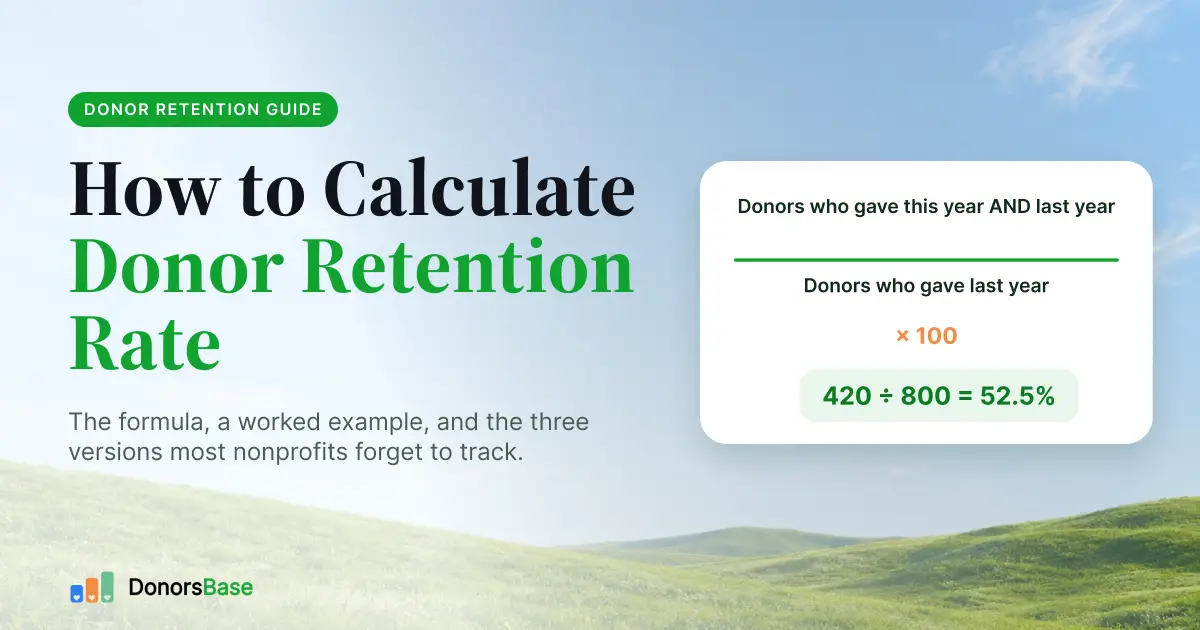
Donor retention rate is the percentage of last year's donors who gave again this year: (donors who gave this year and last year ÷ donors who gave last year) × 100. If 800 people gave in 2025 and 420 of them gave again in 2026, your retention rate is 420 ÷ 800 × 100 = 52.5%.
The donor retention rate formula, step by step
- Pick two periods. Use the same length for both, usually two calendar years or two fiscal years.
- Count last period's donors. Count unique people who gave at least once. A person counts once, however many gifts they made.
- Count how many of them gave again this period. Only people who appear in both lists count. New donors from this period are left out.
- Divide, then multiply by 100.
Do not divide total donors this year by total donors last year. That is a growth rate, and it hides churn: you can grow while losing most of your base.
Worked example
| Item | Count |
|---|---|
| Donors in 2025 | 800 |
| Of those, gave again in 2026 | 420 |
| New donors in 2026 | 150 |
| Total donors in 2026 | 570 |
- Retention rate: 420 ÷ 800 = 52.5%
- Donor growth: (570 − 800) ÷ 800 = −28.8%
Retention looks healthy while the donor base still shrank, which is why you need both numbers.
The three versions to track separately
- New donor retention: donors whose first gift was last year and who gave again this year. This is the weakest point for most nonprofits. The Fundraising Effectiveness Project reported about 19% new-donor retention for full-year 2024, against 42.9% overall. A fast, personal thank-you is the cheapest fix, and our donation acknowledgment letter guide includes a template.
- Repeat donor retention: donors with two or more years of giving who gave again.
- Reactivation rate: lapsed donors (no gift in 12+ months) who came back.
How to calculate retention for monthly donors
Measure monthly donors by monthly churn: donors who cancelled or failed a payment in a month ÷ active monthly donors at the start of that month. Track failed-payment recovery separately, because many "cancellations" are expired cards. To build the monthly base in the first place, see our guide to turning one-time donors into monthly sustainers.
How to calculate it from your CRM export
- Export every gift with donor ID, date and amount for both periods.
- Merge duplicate donors, then reduce to one row per donor per period. Duplicates inflate the count.
- Match the two lists on donor ID and count the overlap.
- Apply the formula.
Donor management software does this automatically and shows it by segment and campaign. See what to look for in a donor management system before you choose one.
What is a good donor retention rate?
Benchmarks vary by source. The Fundraising Effectiveness Project's full-year 2024 sector figure was 42.9%, and its year-to-date 2026 figure through Q2 was 26.4%. Compare yourself to your own history first, then to peers of similar size. Full tables by segment are in our 2026 donor retention rate benchmarks.
Frequently asked questions
What is the formula for donor retention rate?
Donor retention rate = (donors who gave this year and last year ÷ donors who gave last year) × 100.
How do you calculate donor retention rate in Excel or Google Sheets?
List last year's donor IDs in one column and this year's in another. Use COUNTIF or a lookup to count how many of last year's IDs also appear this year, then divide by last year's total and multiply by 100.
Is donor retention the same as donor churn?
No, churn is the opposite. Churn is 100% minus retention, so a 52.5% retention rate means 47.5% churn.
How often should I calculate donor retention?
At least once a year, and quarterly if you can. A quarterly check shows problems while there is still time to fix them before year-end.
Does a gift to a different campaign count as retained?
Yes. Retention counts the donor, not the campaign, so any gift in the new period keeps the donor retained.